Slow on mobile.
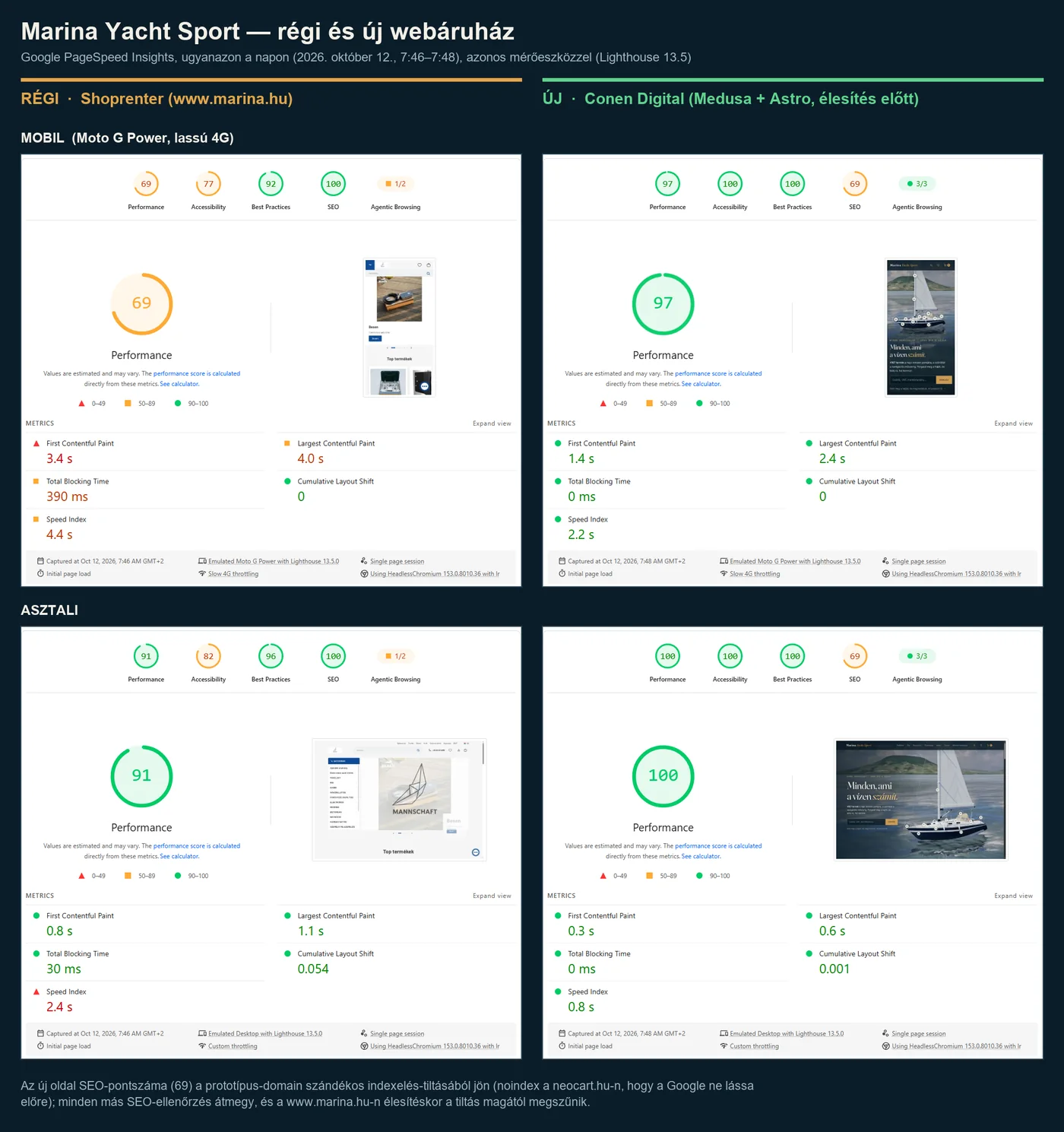
On a phone, the old site showed its main content after four seconds, and stuttered while loading. For someone looking for a spare part from the marina, on a phone, that is a long time — many will not wait that long.
CASE STUDY / WEBSHOP · MARINA YACHT SPORT
Marina Yacht Sport has been equipping sailors for almost 30 years — in its shop in Balatonkenese, and online at marina.hu. More than four thousand products, official representation of major European brands, loyal customers. And a webshop that loaded slowly on mobile, said almost nothing about most of its products, and could easily have lost years of hard-won Google rankings in a move. We rebuilt that shop, from the ground up.
01 / STARTING POINT
A webshop rarely “breaks” visibly.
It quietly loses customers instead —
in places nobody sees.
On a phone, the old site showed its main content after four seconds, and stuttered while loading. For someone looking for a spare part from the marina, on a phone, that is a long time — many will not wait that long.
Thousands of products had no real description, just a name and a price. Shoppers could not tell which rope diameter a block suits, or which lifejacket is right for whom — so they either phoned, or bought elsewhere.
84 per cent of the main product images were smaller than 800 pixels: blurred when enlarged, and the mix of white, transparent and photographic backgrounds made the product grid look cluttered.
The old shop had more than ten thousand URLs indexed in Google. When the shop moves to a new system, these URLs can easily lead to error pages — and the shop could lose in months the traffic it built over years.
02 / THE MEASUREMENT
Google PageSpeed is a score from 0 to 100 for how quickly and smoothly a page appears on an average phone, on slow mobile data. We measured the old and the new shop on the same morning, with the same device.
The new shop’s SEO score in the measurement is 69: that is deliberate. Until launch we disabled indexing on the staging address, so Google would not see the half-finished site early. Every other SEO check passes, and on marina.hu the block lifts automatically.
YOUR SITE?
Request the free speed check: we measure how fast your site appears on mobile, then talk through with you what is worth improving.
03 / WHAT THE SHOP GAINED
Ten changes that shoppers
and the shop team will both feel first-hand.
The shop preloads in the background the page you are likely to click, so it is often already there by the time you arrive. On mobile the main content appears in 2.4 seconds, with no stutter.
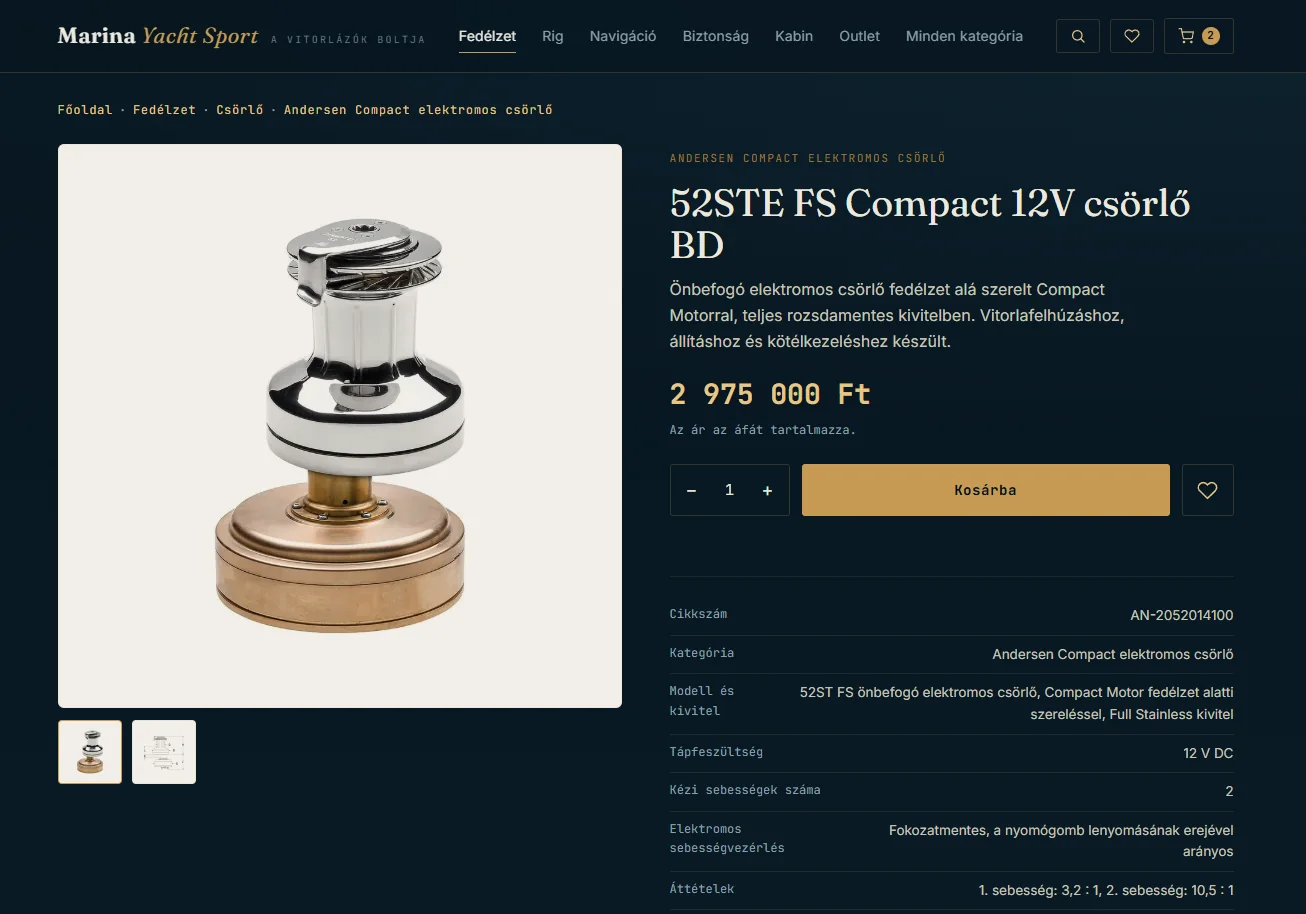
All 4,167 products received a professional description in Hungarian. We collected the data from the manufacturers’ official datasheets, with the source shown next to every specification. Artificial intelligence helped with the work, but uncertain points are decided by the shop’s specialist, in a simple interface built for the job.
For 1,240 products the manufacturer’s own high-resolution photo replaced the old, small image, and the remaining images received a uniform frame. There are no AI-generated product images: what you see is the real product.
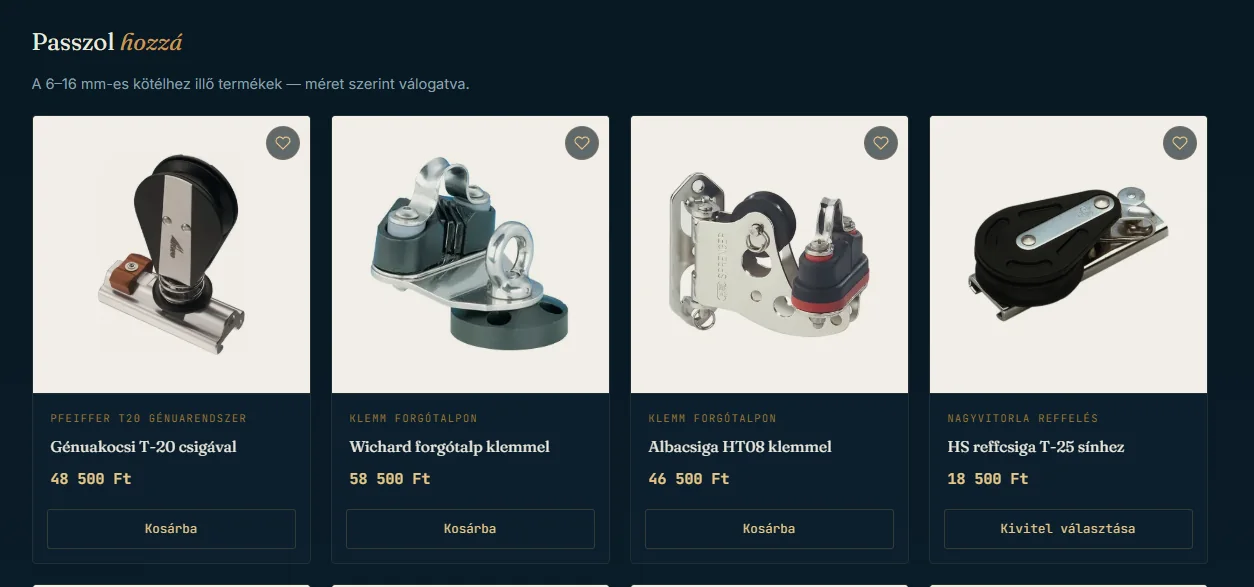
The shop knows the sizes. Next to an 8 mm rope it recommends the blocks, clutches and winches that an 8 mm rope genuinely fits — on the product page and in the basket too. Until now only the salesperson behind the counter could tell you that.
It finds results without accents too — “kesztyu” returns the same as “kesztyű” — and searches by product code. The shop’s featured brands come first.
Alongside home delivery you can choose from 4,111 GLS parcel points and lockers, by postcode. The parcel label is created from the order with a single click.
Card payment with SimplePay. After a successful payment the invoice is created automatically, so the shop team does not need to deal with it.
We tested all 10,836 URLs of the old shop. Remaining products live on at their old addresses; where something changed — merged size variants, for example — the old link automatically takes you to the right new page. The 40 old expert articles and information pages remain too, at the same addresses.
More and more people ask ChatGPT or Gemini what to buy. The new shop describes its products in machine-readable form too — price, stock, manufacturer barcode — and provides a product feed for Google Shopping.
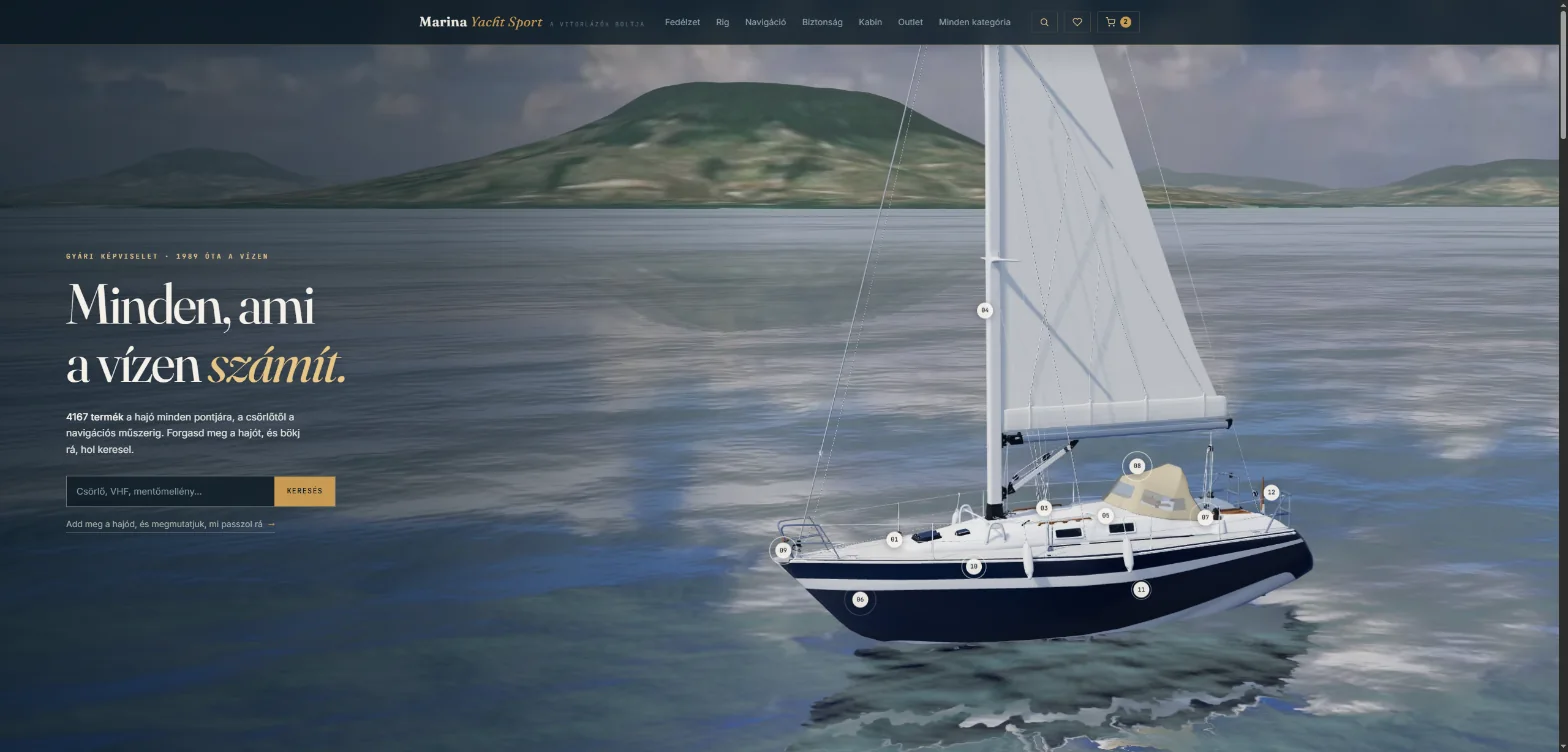
The 3D boat on the homepage only loads once all important content is already on screen. So the visuals do not compromise speed, and anyone who just wants to search can search straight away.
04 / HOW WE WORKED
The decision was based not on paper,
but on a shop working with real products.
We built a working demo shop with Marina’s real products. The owners could click around in it before deciding anything.
The full range moved into the new system: products, size and colour variants, categories, images — and every product received a new description.
Basket, delivery, card payment, invoice, parcel label: we tested every step with real trial orders, on phone and computer.
The new shop replaces the old one at marina.hu at the end of November 2026, after the sailing season. All old links keep working.
FREQUENTLY ASKED QUESTIONS
It helped: it collected the data from the manufacturers’ datasheets and wrote the first draft of the descriptions. Every specification is shown with its source, the manufacturer barcode is added only if it verifiably appears on the manufacturer’s site, and a person always resolves uncertainties and makes decisions about safety products.
They stay. Products and categories live on at their old addresses, and the old address of removed or merged pages automatically redirects to the right new page. We machine-tested all 10,836 URLs of the old shop, and after launch we will run the same check again on the live address.
Because until launch we deliberately disabled indexing on the staging address, so Google would not see the half-finished shop early. This is the only failing point in the SEO check, and it clears automatically on the final address.
The working prototype was finished in the summer. Actual development started in early October 2026, with launch at the end of November — after the sailing season, when a switchover disturbs the fewest shoppers.
Yes. The first step is always a measurement: we look at where your current shop loses customers — speed, product pages, checkout, search — and that shows what pays off most.
LET'S START WITH A CONVERSATION